Know What Is Below.
Dig With Greater Confidence.
Professional private utility locating, surface marking, conflict-area documentation, and pre-excavation support for commercial and institutional properties.
Locate Privately Owned Lines Beyond the Public Meter
North Carolina 811 coordinates the marking of participating public utility facilities, but privately owned lines beyond the meter or service point may not be included. Those unmarked facilities can create costly conflicts during irrigation work, landscaping, sign installation, fencing, drainage improvements, lighting upgrades, and other excavation.
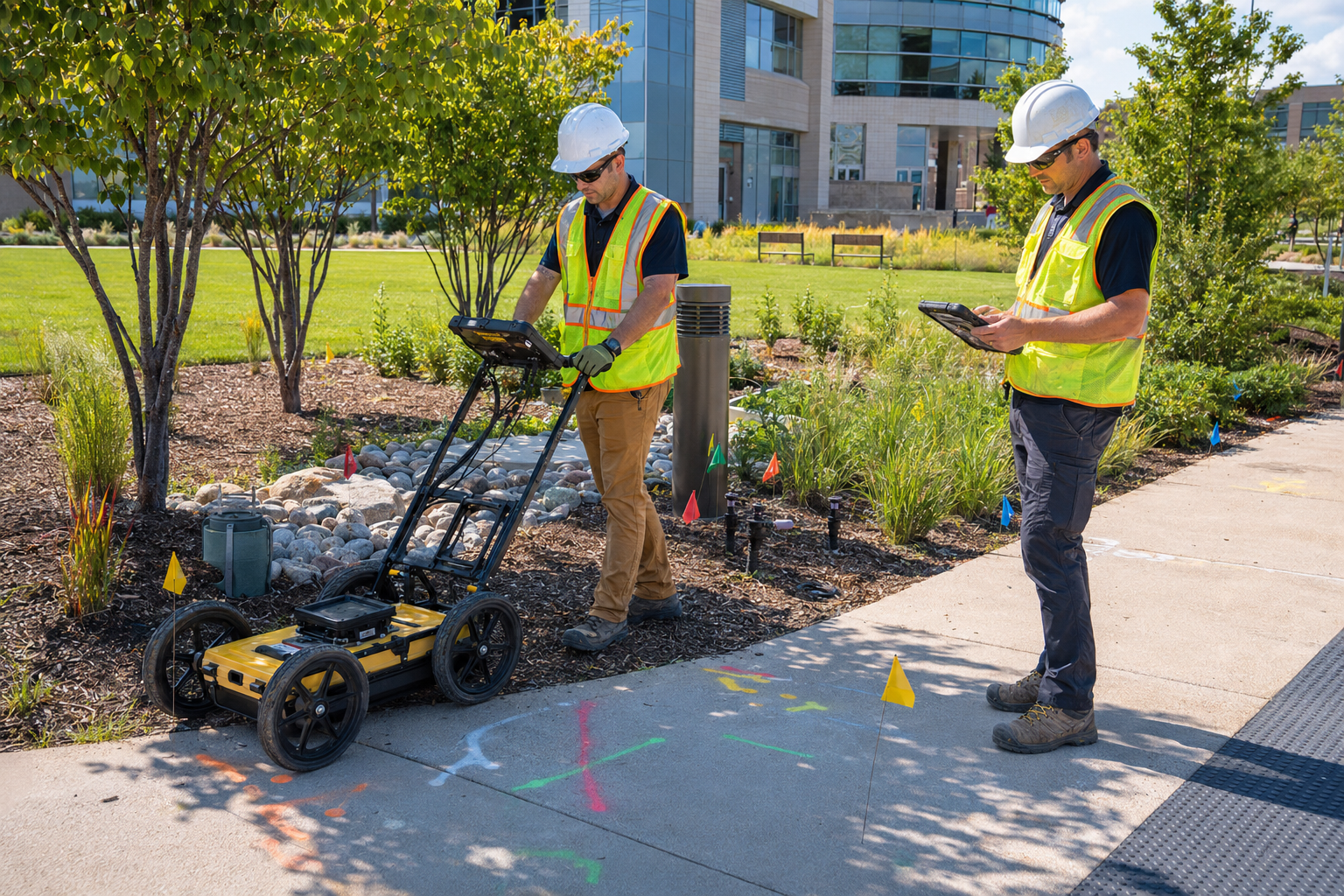
Koster Irrigation helps commercial property owners, facility teams, municipalities, HOAs, schools, contractors, and landscape managers identify and mark accessible private utilities within a defined work area. We combine records review, site observations, electromagnetic locating, compatible ground-penetrating radar, surface marking, and clear field documentation to support better planning before ground is disturbed.
Private Utility Locating & Marking Services
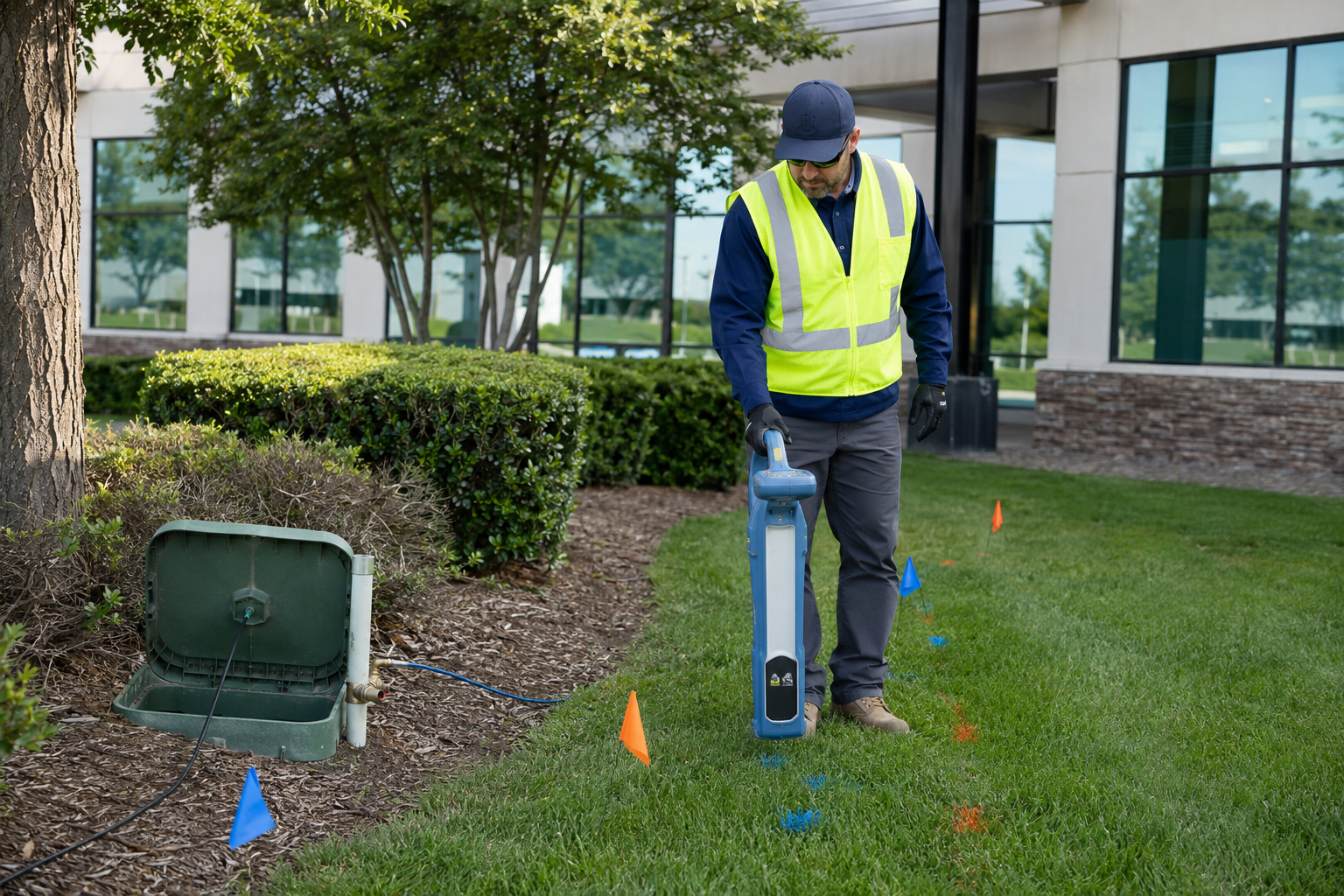
Private Irrigation Line Locating
Trace accessible irrigation mainlines, lateral routes, control wiring, valves, sleeves, and related components within the requested work area.
Private Electrical & Lighting Locates
Identify detectable privately owned electrical feeds, site-lighting circuits, gate power, and similar facilities beyond the public service point.
Communications & Low-Voltage Locates
Trace accessible data, security, access-control, landscape-lighting, and other conductive low-voltage routes where conditions allow.
Ground-Penetrating Radar Support
Use compatible GPR scanning to investigate selected conflict areas, nonconductive targets, abandoned routes, or unclear subsurface conditions.
Surface Marking & Conflict Zones
Mark detected routes with appropriate temporary paint or flags and identify areas where planned work crosses or approaches a private facility.
Site Documentation & Coordination
Provide field notes, photos, sketches, or marked-site information as agreed and coordinate findings with owners, managers, and project teams.
Reduce Unknowns Before Excavation Begins
Private utility locating adds a focused layer of subsurface information after the appropriate 811 process and before excavation. A professional locate cannot guarantee that every buried object will be found, but it can substantially improve planning when records are incomplete and privately owned facilities are outside the public one-call scope.
Reduce Damage Risk
Identify detectable private lines before trenching, boring, grading, planting, fencing, sign installation, or other ground-disturbing work.
Protect Operations & Property
Help avoid service interruptions, emergency repairs, schedule delays, landscape damage, and unexpected conflicts with active facilities.
Improve Project Planning
Give contractors and property teams clearer routing information before labor, equipment, materials, and excavation are committed.
Create Better Site Records
Capture useful field information for future maintenance, renovations, irrigation repairs, capital improvements, and facility management.
From Scope Review to Marked Work Area
Define & Review
Confirm the work area, proposed excavation, known utilities, available plans, access points, site contacts, and the status of the required 811 request.
Walk & Trace
Inspect visible features and trace accessible facilities using appropriate electromagnetic methods, sondes, or compatible GPR scanning.
Mark & Document
Apply temporary surface markings or flags, identify conflict areas, and record agreed findings with photos, notes, sketches, or field maps.
Review & Coordinate
Walk the marked area with the project contact, explain limitations and uncertainties, and coordinate additional investigation where needed.
Private Utility Locating Across the Koster Service Area
Koster Irrigation provides private utility locating for commercial and institutional properties in Raleigh, Durham, Wilson, Rocky Mount, Greenville, Goldsboro, Apex, Garner, Clayton, and surrounding Eastern and Central North Carolina communities.
- Commercial campuses, office parks, HOAs, schools, retail centers, industrial sites, municipalities, and managed properties
- Defined work-area locating for irrigation, lighting, communications, water, and other accessible private facilities
- Field markings and documentation coordinated with owners, contractors, facility teams, and landscape professionals
- Support for renovations, irrigation projects, drainage, signs, fencing, planting, and other planned excavation
Request a Private Utility Locate
Tell us where the work will occur, what type of excavation is planned, which private facilities may be present, and when your project is scheduled. Koster will help define the locating scope and next step.
Helpful Resources for Your Project
Planning a new installation or comparing irrigation contractors? These Koster Irrigation resources can help you make informed decisions.
Frequently Asked Questions
Answers to common questions from property owners, facility teams, municipalities, HOAs, contractors, and landscape managers planning excavation around privately owned underground facilities.
Private utility locating is the process of identifying and marking detectable underground facilities that are privately owned and may not be covered by the public 811 notification system. Examples can include irrigation lines, site lighting, secondary electrical, communications, water or sewer laterals, gate systems, and facilities beyond a meter or service point.
No. Contacting North Carolina 811 is an essential first step before excavation. Private locating is a separate service used for facilities that member utility operators do not own or mark. Project teams should complete the appropriate 811 process and then arrange private locating where privately owned lines may be present.
Depending on access, construction, materials, records, and site conditions, Koster can investigate private irrigation piping and wiring, site lighting and electrical feeds, communications and low-voltage routes, water services, sleeves, valves, and other detectable facilities within an agreed work area.
Methods may include records review, visual site inspection, electromagnetic locating with a transmitter and receiver, sondes or traceable components, and compatible ground-penetrating radar scanning. The best method depends on the target material, depth, access points, soil, congestion, and site conditions.
Some nonconductive pipes can be traced when a conductive wire, sonde, accessible insertion point, or distinctive GPR response is available. A pipe with no tracer, access, records, or detectable contrast may not be locatable. Koster will explain known limitations and recommend additional investigation when appropriate.
Detected routes are typically identified with temporary paint, flags, or other agreed surface markings using appropriate utility color conventions. Markings show the interpreted path within the defined work area; they do not reveal every characteristic or eliminate the need for careful excavation practices.
Accuracy varies with line material, depth, signal quality, congestion, soil, access, records, and equipment limitations. Locating provides an interpreted field result, not a guarantee that every buried object has been found. Verification methods such as careful exposure or vacuum excavation may be appropriate near critical conflicts.
Provide the property address, site contact, planned excavation area, project type, desired schedule, available utility plans, known access points, suspected private facilities, and the status of the 811 request. A clearly defined work area helps Koster prepare the correct scope.
Schedule it after project limits are defined and with enough time to review results before digging begins. Temporary markings can fade or be disturbed, so coordinate the locate close enough to the work date that markings remain useful and request a refresh if conditions change.
Koster serves commercial and institutional properties in Raleigh, Durham, Wilson, Rocky Mount, Greenville, Goldsboro, Apex, Garner, Clayton, and surrounding Eastern and Central North Carolina communities. Contact Koster to confirm availability and the scope required for your property.
Ready to Locate Before You Excavate?
Reduce uncertainty with a defined private utility locating scope, professional field methods, clear surface markings, and practical site documentation.