
Customer Resources

Irrigation

Maintenance Checklist

Keep your system running efficiently with seasonal maintenance tips from Koster Irrigation.

Irrigation Repair

Why irrigation maintenance matters

Simple seasonal maintenance can help you avoid expensive breakdowns, reduce water usage, and keep your irrigation system running efficiently year-round.

Maintenance Checklists

Maintenance checklist

Simple maintenance steps that help save water, prevent repairs, and keep your irrigation system performing its best.

System Maintenance

Irrigation

From new installations to ongoing maintenance, we provide reliable irrigation solutions tailored to your property's needs.

Water Conservation

Completed inspection

Thorough system inspections help identify potential issues early, ensuring reliable performance and preventing costly repairs.

Irrigation Maintenance and Tune Up Check List:

Look For Leaks
System Inspection System Inspection

  • With your system controller turned off, turn off all watering and read your system water meter.  On the water meter face is a red triangle.  On some meters, this may be a red “star”.  If this is moving clockwise, you may have a water leak.   Shut the meter off asap and call us to set up a service visit.    You may either have a leak in the PVC mainline piping or a zone control valve that is weeping and not shutting down fully. 
  • If your system is served by a Well, have us check your system.  We have the skills and methods to determine water leaks and usages.  
  • Operate each zone and check for leaks.    Leaks can sometimes occur only while the sprinklers are in operation, on the lateral line piping.  Either due to a crack in the PVC piping or at a sprinkler connection joint.  You will usually notice water bubbling up from the ground, and puddling,  Sometimes not near or related to a sprinkler head.   If this occurs, Turn the zone minutes down to zero on the controller to effectively skip over this zone until it is repaired. 
  • Make sure the clock is set for the proper day of the week and time of day is correct.
  • Make a list of all the stations and where they water.  Include type of plant being watered and type of
    heads.  Place list in the controller for future reference.
  • Some older controllers have a battery backup for the clock, such as a 9 volt.  Replace it at the beginning of each watering season.   Newer controllers,  including some Rainbird or Hunter models have internal non-volatile memory and do not need battery replacement,   They also have a internal rechargeable battery for holding the clock during a power outage.    You can check this by unplugging your controller from the wall-  Wait a minute then power back up and recheck to see if the clock holds. rotor_1_
Inspect System

  • Repair or replace broken or worn rotor heads, spray heads, and drip emmitors.
  • Make sure all heads pop-up all of the way and fully retract when the water is turned off.   If they do not pop down,  They will soon be clipped by mowing equipment. 
  • Check for sprinklers blocked by grass, plants or other obstacles.  If the spray is blocked, remove the obstacle or move the sprinkler head.   Sprinkler heads can be raised if they are too low or have settled. 
  • Make sure sprinklers are vertical and flush with soil grade. Soil should be tightly compacted around the sprinkler.  Crooked sprinklers cannot effectively water a lawn.
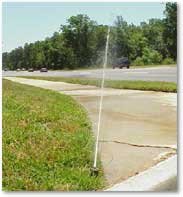
  • Check for proper pressure.  Water will stream out of the sprinkler instead of forming a spray if the pressure is too low or mist excessively if it is too high.
  • Clean or replace clogged nozzles.   If a system has set up unused for a long period of time, (Years)  It is normal for the need to unclog or replace nozzles.   
  • Make sure all heads direct water to landscape and not to impervious surfaces such as concrete.


Set Schedule

  • Water at night, preferably between midnight but no later than 7 AM.
  • Determine the maximum run time for each zone before run off starts. This often occurs after about 5-10
    minutes for clay soils or after 18 minutes for loamy sand soils.  Decrease these times for slopes.  If
    runoff is a problem, irrigate more often for shorter periods, waiting at least an hour between watering.
  • Make sure the sensor is properly installed, set at one-fourth of an inch or less, and not sheltered by walls, shrubs, or trees.  If your controller has a sensor switch, make sure it is always set to “Active” mode,  Not Bypass.  
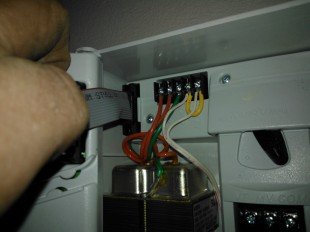
  • The picture below represents an improperly connected rain sensor wire.   The yellow “loop” jumper wire was left by the previous installer, and thus made the rain sensor useless.   If you are uncertain if the wiring is correct, please give us a call.  
Sensor Jumper Wire

  • It is very important to have your system properly drained each winter.    For the majority of systems,  The water source needs to be shut off and the backflow preventer device needs to be drained.   Please contact us for further information regarding winterizing your system.  This service needs to be done in November. 

Always FLAG Sprinklers Before You Aerate!!   Aerators are the #1 Cause of sprinkler damage!

Need Help With Your Irrigation System?

Whether you need a seasonal inspection, system repairs, upgrades, or a complete irrigation installation, Koster Irrigation is here to help keep your landscape healthy and your system operating at peak performance.